Concept
What Is Shika (紫霞)?
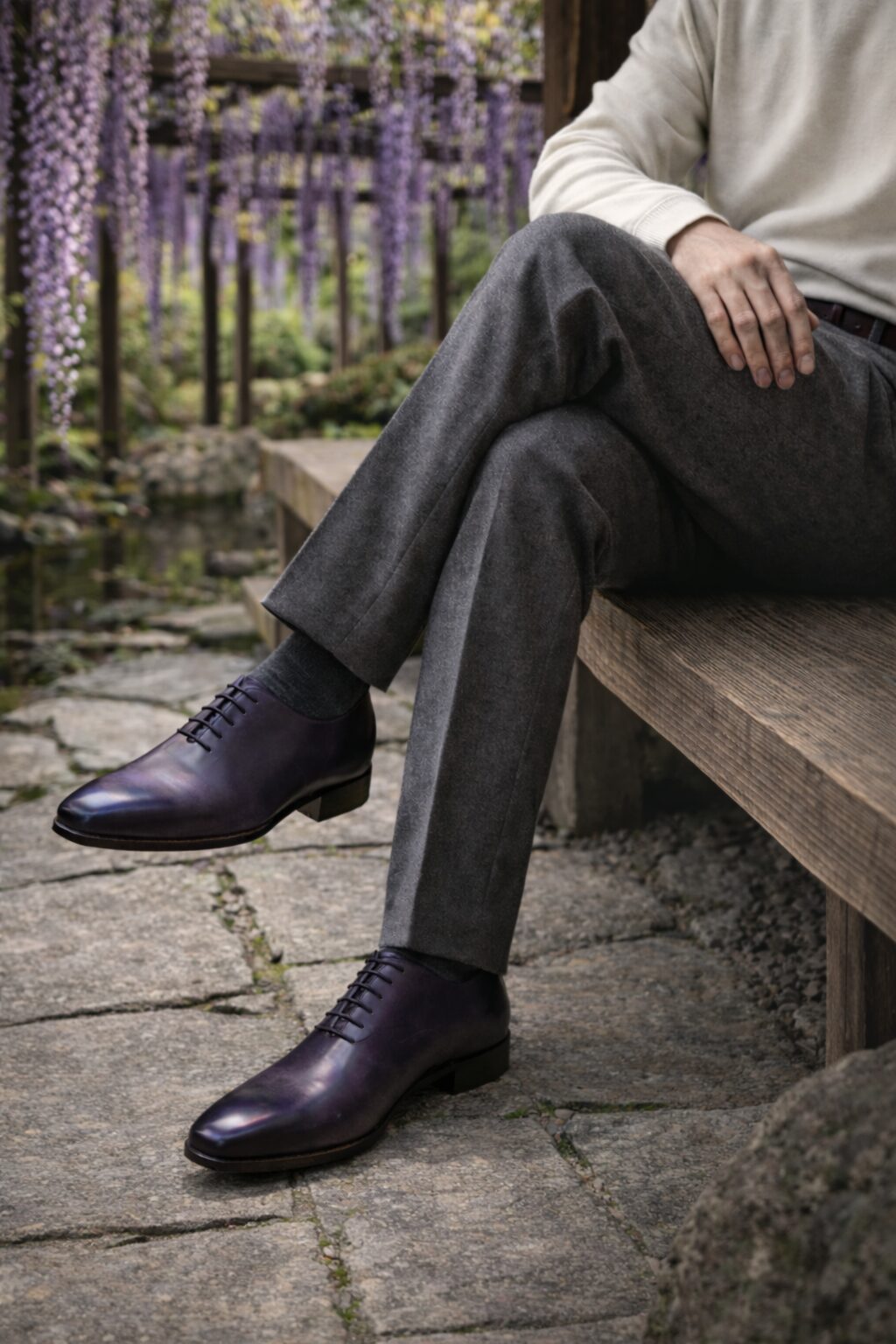
Shika (紫霞) refers to the subtle hue of mist (kasumi) tinged with violet as it drifts across the sky at dawn or dusk. It is neither a clearly defined purple nor a simple gray, but rather a veil-like tone in which purple is gently suspended within haze—often perceived as violet-infused gray-white or wisteria softened by mist. Shika is not a color with a fixed boundary. It is a color born from light, air, distance, and time, captured at a fleeting moment when forms dissolve and atmosphere takes precedence. In this sense, Shika is less a pigment than an impression, crystallized through Japanese aesthetic sensitivity.
Context
Historical and Cultural Context in Classical Japan

In ancient Japan, purple was the most prestigious of colors, reserved for the Emperor and the highest-ranking aristocracy. As a result, refinement was not expressed through vivid saturation alone, but also through restrained, softened purples that preserved dignity without overt display. Shika embodies this principle. Rather than asserting purple directly, it dissolves nobility into atmosphere, maintaining grace through subtlety—an aesthetic deeply aligned with Heian ideals of moderation and elegance.
In classical waka poetry and narrative literature, kasumi (mist) is not merely a meteorological phenomenon. It functions as a poetic symbol of spring, dawn, transition, and the liminal realm between worlds. When infused with the presence of violet, mist acquires connotations of nobility, mystery, and spiritual depth. Shika thus emerged not as a literal color description, but as a mental landscape, embedded in literary imagination rather than physical observation.
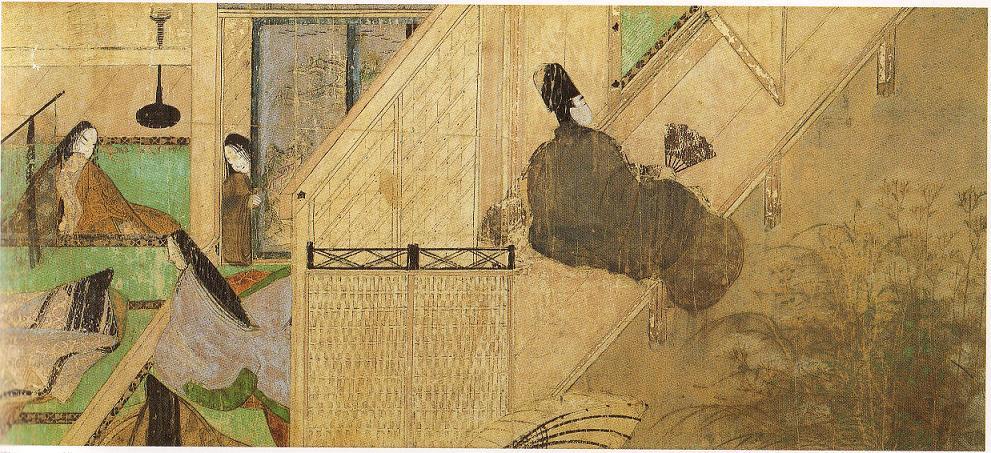
From the late Heian to early Kamakura periods, illustrated handscrolls (emaki) employed pale violet-gray layers to depict distant mountains, sky, and atmospheric depth. These hues did not aim to replicate the sky’s actual color. Instead, they functioned as visual devices to convey distance, time, and narrative space—a pictorial realization of what Shika represents conceptually.
Pictorial Space
Shika in Emaki and Pictorial Depth
From the late Heian to early Kamakura periods, illustrated handscrolls (emaki) often used pale violet-gray layers to suggest distance and atmosphere. These hues were not intended as literal sky color.
Rather, they operated as a pictorial device—an instrument for dissolving edges, softening forms, and letting “air” become part of the narrative space. In this sense, Shika is less a color than a method: a way of staging time, depth, and quiet nobility through restraint.
Seasonality
Affinity with Spring — Shika and “Spring Dawn”
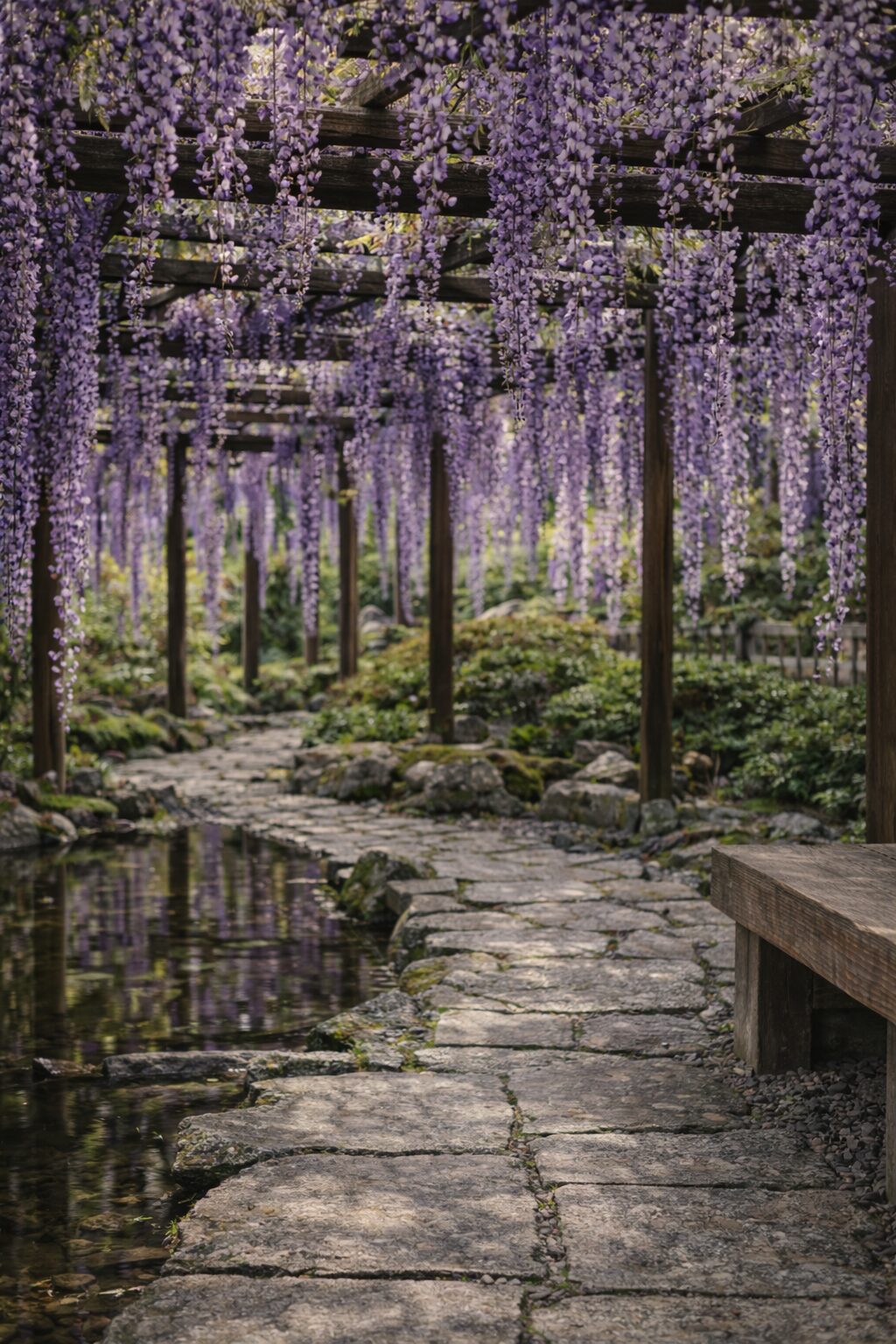
In Japanese aesthetic tradition, seasons are distinguished not only by temperature or scenery, but by atmospheric perception. Autumn is associated with kiri (fog), while spring is defined by kasumi (mist). Fog is heavy and cold, obscuring form. Mist, by contrast, is soft, luminous, and enveloping. Shika aligns naturally with kasumi, and thus with spring.
When positioned as the color of “spring dawn” (haru no akebono), Shika’s seasonal character becomes unmistakable. This interpretation resonates directly with the sensibility articulated in The Pillow Book (Makura no Sōshi): “In spring, it is the dawn that is most beautiful…”
Shika captures the precise instant when night has not yet departed, and morning has not yet fully arrived— a color of beginning, sensed rather than seen.
Meaning
Symbolism
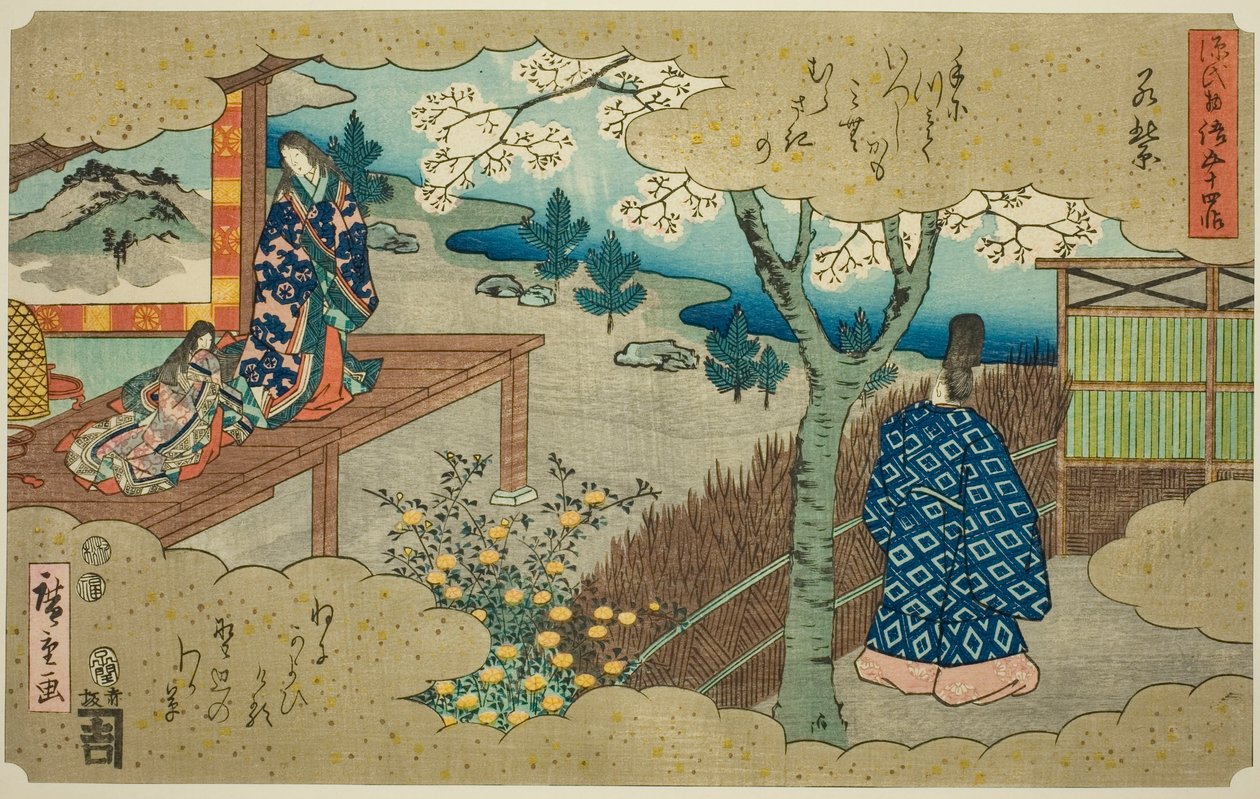
Utagawa Kunisada (Toyokuni III)
The Tale of Genji: Wakamurasaki
Late Edo period (early 19th century)
Polychrome woodblock print (nishiki-e)
Public domain image / Collection unknown
| Presence and Suggestion | Beauty perceived not through clarity, but through implication—central to Japanese aesthetic sensibility. |
|---|---|
| Restrained Nobility | The highest color, purple, softened and dissolved into mist to preserve dignity without display. |
| Beginning of Spring | A color that appears at the threshold between winter and spring, night and morning. |
| Liminality | Expresses the boundary between worlds: reality and imagination, this shore and the beyond. |
| Spiritual Quietude | Suppresses visual intensity, guiding awareness inward toward contemplation and stillness. |